
Ask a room of shipping people to draw their industry and most will draw a dry container. Ask the same room about the box that carries liquids, and the conversation turns to the ISO tank model — the miniature of the tank container that moves chemicals, base oils and food-grade liquids around the world. If you buy corporate gifts for a chemical logistics operator, a tank leasing company or a port, this is the guide we wish someone had handed you years ago.
We have built ISO tank models for fourteen years — since 2012 — alongside the container and vessel programmes our workshop is known for. This guide covers what a tank container actually is, why the T11 type dominates enquiries, how scale and material choices work, and the practical questions of sampling, branding and lead times. It is written from our own quoting desk, not from a reseller’s catalogue.
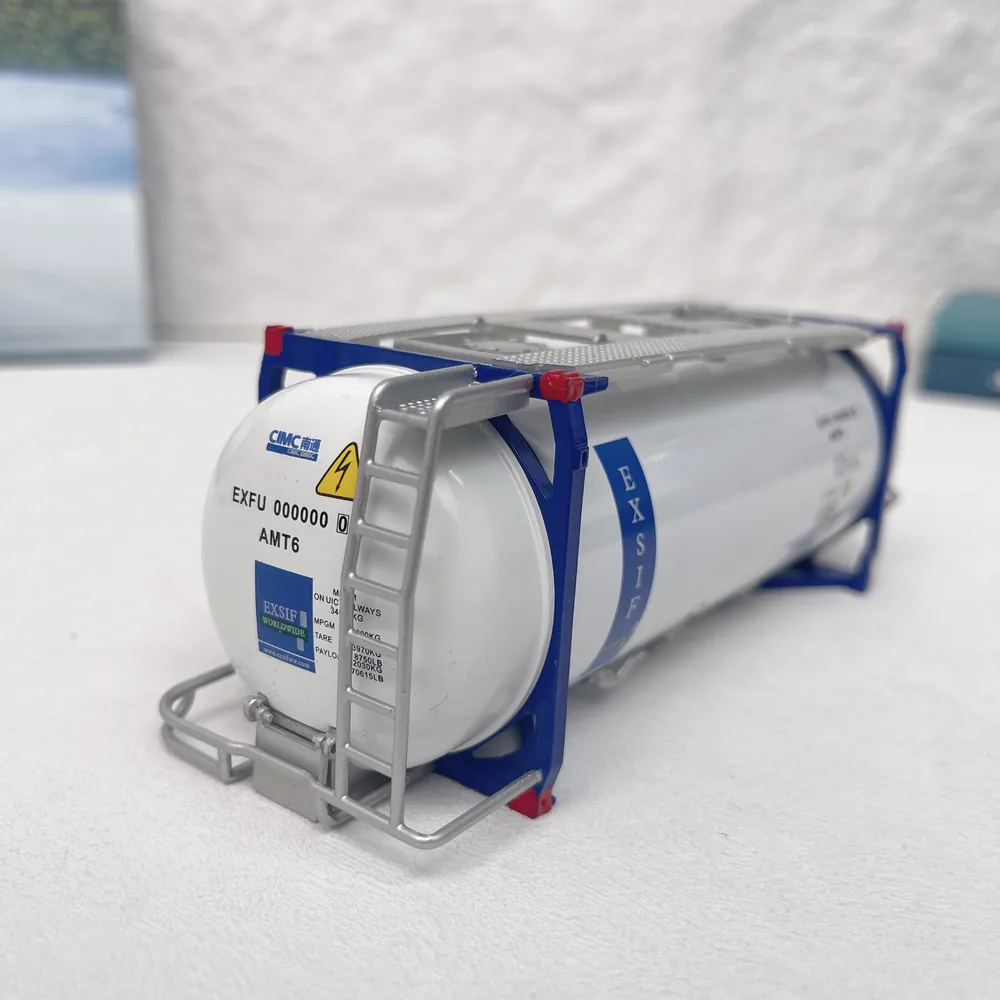
1. Why ISO tank models earn a place on the desk
Liquid bulk has an identity problem. Dry containers are famous — the corrugated box is a design icon — but the tank container, which carries a similar share of the world’s chemical trade, is far less recognisable outside the industry. That is precisely why a well-made tank model lands so well with the people who live in this trade: it says we know who we are.
In our enquiry statistics, ISO tank requests consistently rank among the top four product lines — behind ship models and desk containers, but ahead of most other categories. Tank operators, leasing companies and ports order them as executive gifts, exhibition pieces and long-service awards. A tank model on a desk does what a vessel model does for a shipping line: it makes the company’s daily work visible.
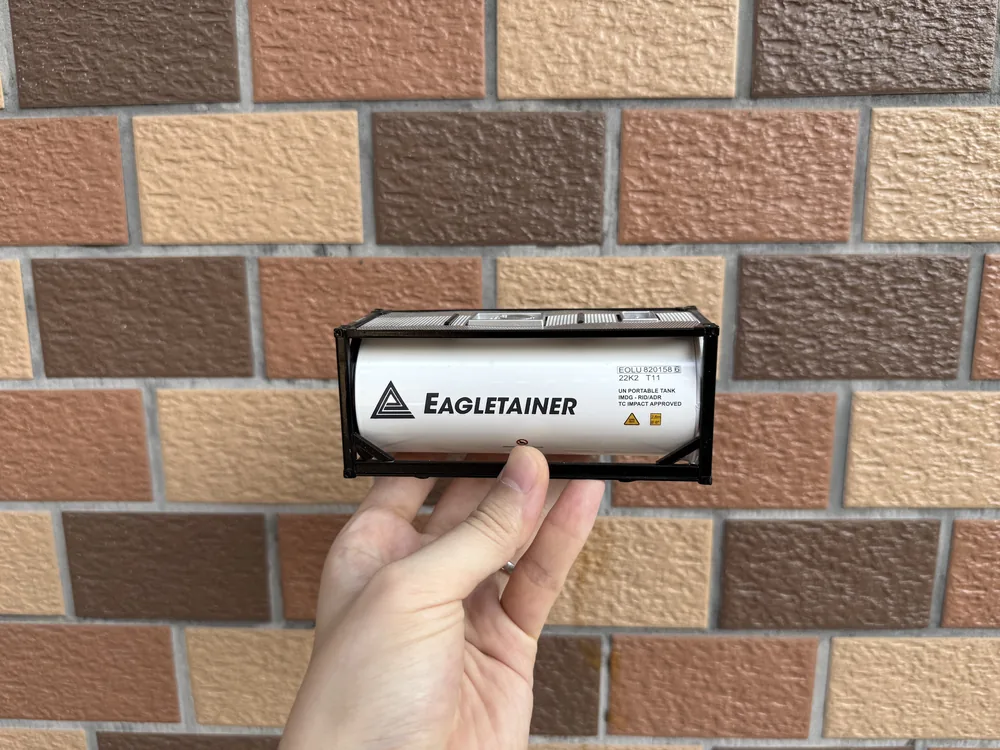
2. What an ISO tank container actually is
A tank container is a cylindrical pressure vessel mounted inside a frame that matches the dimensions of a standard 20-foot container under ISO 668. The frame — with the same corner castings as any dry box — is the clever part: it lets the tank stack in a ship’s cell guides, clip onto a road chassis and ride a rail wagon without modification. One steel frame, three transport modes.
The tank inside typically holds somewhere between 21,000 and 26,000 litres, depending on the cargo and the design. Cladding, walkways, ladders and a set of valves and fittings at the rear complete the picture. If you want the wider story of the box system the tank rides inside, our history of the shipping container covers it in plain English.
3. Meet the T11: the type buyers ask for first
Tank containers are built to a family of UN portable tank instructions, and the code most clients quote is T11. In practice, a T11 is the general-purpose, non-insulated, non-refrigerated tank for liquid cargoes — the type you see carrying solvents, lubricants, additives and food-grade liquids in the largest volumes. When a chemical logistics company asks us for a tank model, T11 is the default answer in the overwhelming majority of cases.
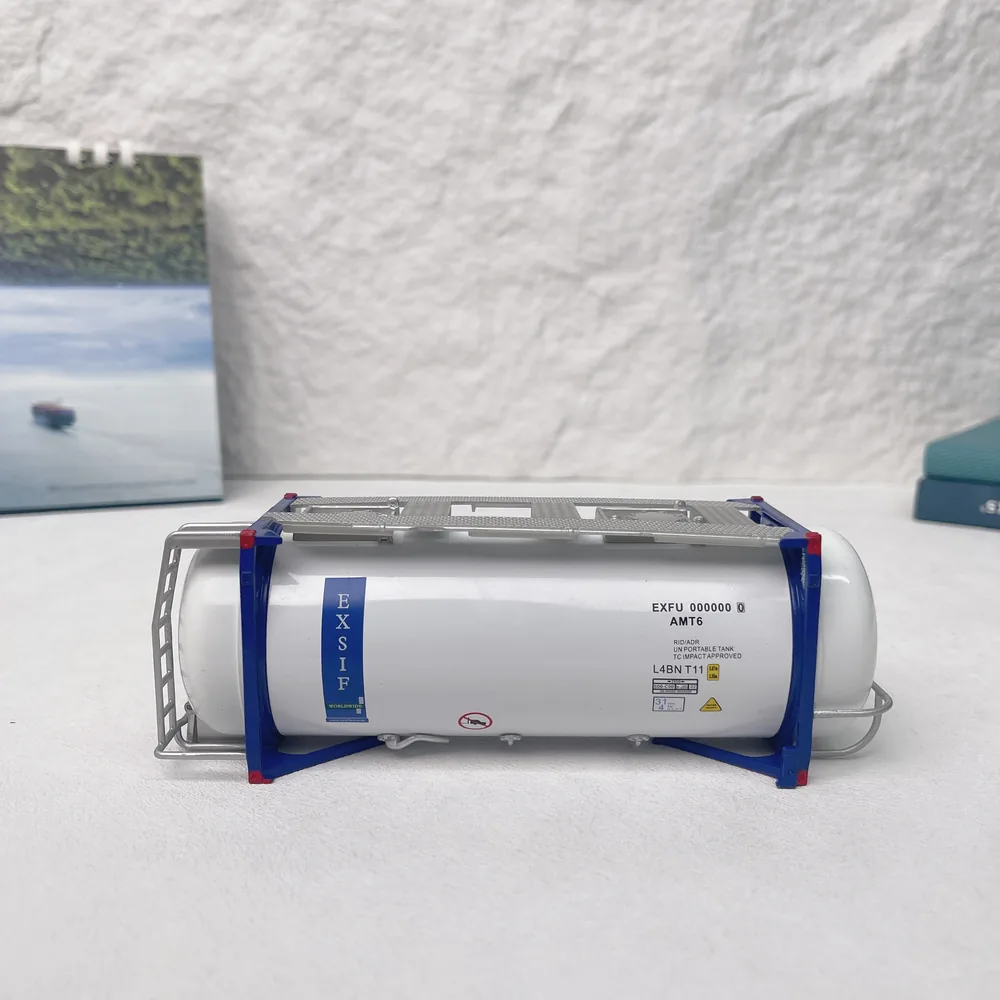
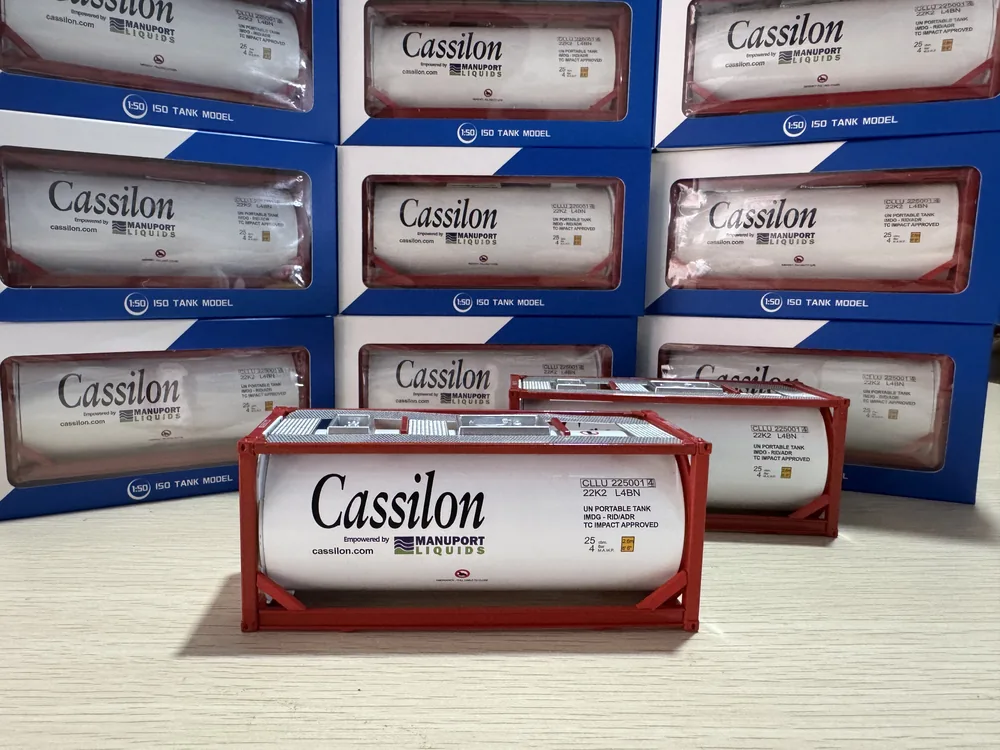
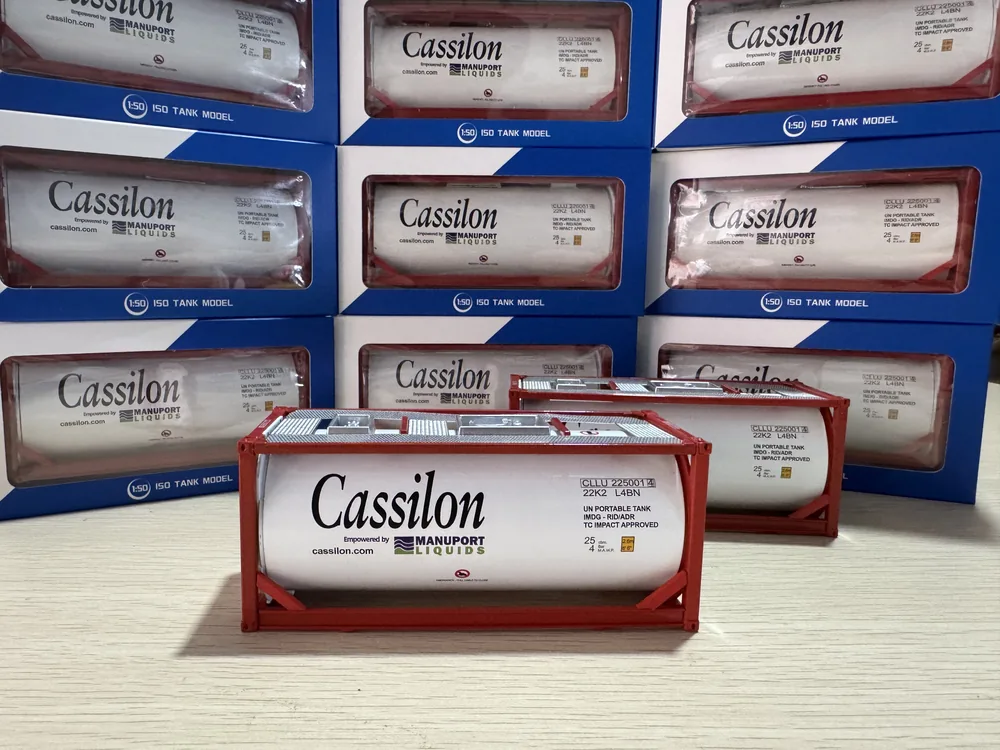
Other instructions exist — insulated, refrigerated, swap-body and gas types among them — and we have quoted them. But for a gift programme, T11 is what the recipient will recognise as “the tank I see at work every day”. Our 1:50 T11 ISO tank model is built around exactly that type, with the barrel, frame and walkway geometry faithful to the real unit.
4. Scale and material: why 1:50 zinc alloy is the default
The standard offering in this category is a 1:50 scale ISO tank model. At 1:50, a 20-foot tank container becomes roughly 12 centimetres long — large enough to show the frame detail and valve array, small enough to sit on a desk beside a monitor. If you are weighing scales for a wider programme, our model scale guide walks through the same logic for containers and vessels.
Material matters as much as size. Our T11 shells are die-cast in zinc alloy, a material chosen for dimensional stability, colour accuracy and a finish that survives handling, packing and long-distance freight. A resin print can look right out of the box; an alloy casting feels like equipment. That weight in the hand is one of the quiet reasons the tank model gets kept rather than binned — a point we also make in our corporate gifting buyer’s guide.
5. Markings and livery: where replica quality shows
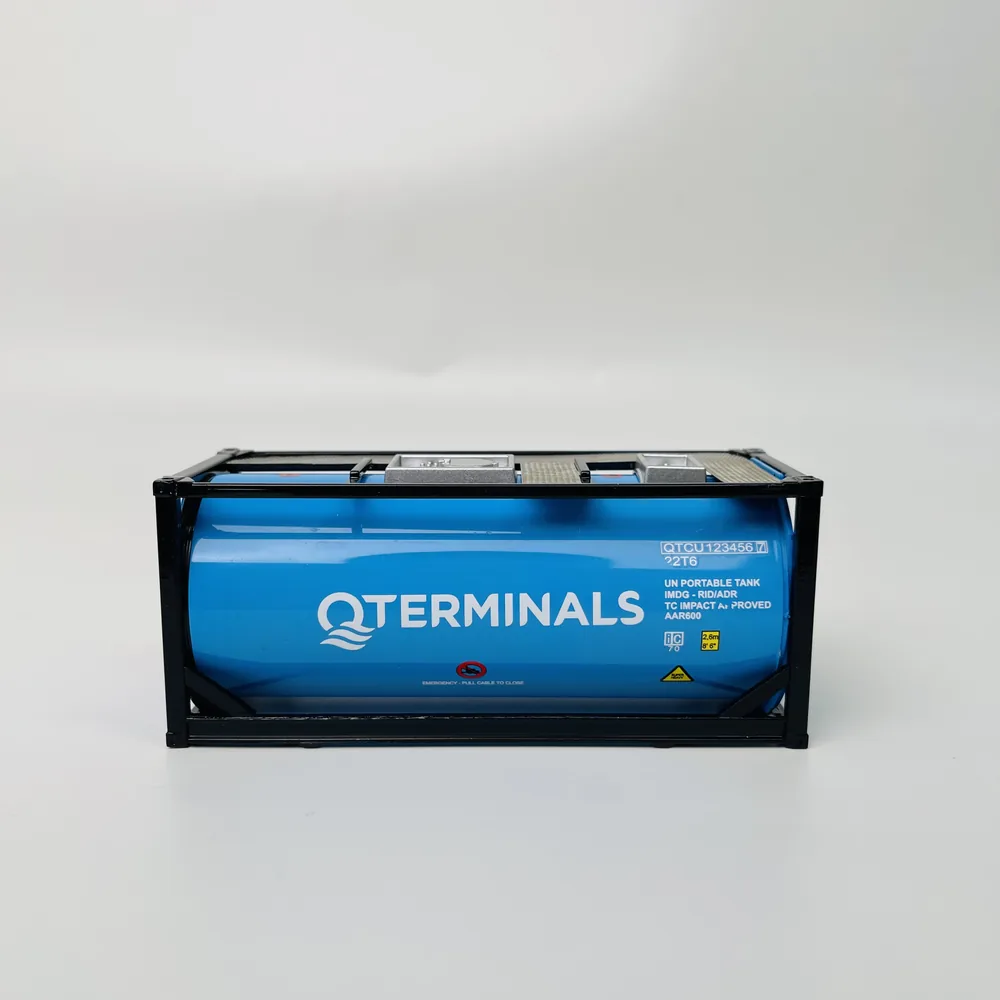
Shipping people read equipment the way pilots read instruments, and a tank model is judged the same way. The real tank carries a strict set of markings under ISO 6346 — owner code, serial number, check digit and a size-and-type code from the T-code family — plus data plates and safety placards. We reproduce these from the client’s actual fleet data, because a fictional code on a desk model is exactly the kind of detail a fleet manager will spot. Our container markings guide explains the full system.
Livery is applied at production, not printed on afterwards. Barrel colour is matched to the client’s PANTONE or RAL reference, logos and wording are proofed against master artwork, and the frame, walkway and cladding follow the fleet specification. Send us vector artwork (AI, EPS or PDF), your colour references and brand guidelines — we proof everything against your files before a single casting is painted.
6. The questions buyers ask us first
Three questions dominate the first reply on a tank enquiry, so let us answer them the way we answer them on the quoting desk.
How many pieces do we need? ISO tank models start at 100 pieces, covering one livery and one packaging specification per run. Tooling, casting, finishing and Pantone matching are set up once, so a tank programme is quoted from that quantity rather than piece by piece. Tell us the number you are planning and we confirm the schedule before you commit.
Can we see a sample? Yes, and you should: a sample is the normal first step. Samples are charged; ordinary items take 1–2 weeks, alloy models about one month. Depending on the order volume, the sample fee is credited against the order in part or in full — so a serious programme rarely pays twice.
How long does production take? Around 30–45 working days after the pre-production sample is approved, with larger volumes adding 10–15 days. If a new design has to be developed with new tooling, allow 3–4 months — occasionally 5–6. We would rather set an honest schedule than a hopeful one.
7. Five mistakes to avoid when ordering branded tank models
Mistake 1: sending a low-resolution logo. A screenshot pulled from a website will not survive proofing at 1:50 scale. Vector artwork — AI, EPS or PDF — keeps the logo crisp on a barrel that is barely 6 centimetres across.
Mistake 2: inventing the markings. Owner code, serial and check digit should come from the real fleet, or be calculated properly for a campaign model. Generic codes are the fastest way to make the gift look like a toy.
Mistake 3: guessing the colour. “Our orange” is not a specification. PANTONE or RAL references turn a colour debate into a five-minute sample check — and tank liveries are mostly colour.
Mistake 4: leaving artwork to the last week. Artwork proofing, sample approval and mass production run in sequence. Compressing the front end pushes the delivery date; the production clock starts when the sample is approved.
Mistake 5: ordering a one-off for a whole department. If the tank model works, colleagues will ask where theirs is. Programmes of even modest quantity — packed in branded presentation boxes — land better and cost less per piece than a single hero unit.
8. How a tank model programme runs in our workshop
Our workshop in Shenzhen sits inside the logistics ecosystem the models depict. A tank programme starts with the fleet reference — photographs, dimensions, colour codes — then moves through digital mock-up, charged sample, sample approval and mass production. Die-cast T11 barrels are cast, finished and Pantone-matched in batches, frames and walkways are fitted by hand, and inspection is staged batch by batch.
On volume programmes, clients inspect with us — in person or by live video — sampling units across batches before packing. Presentation packaging, export cartons and mixed-carton consolidation with other items in the range are all part of the same run. The process is the same discipline we describe in how our models are built, tuned for a product that is small, dense and unforgiving of detail errors.
9. Where tank models fit in a gifting programme
The buyers we quote most often fall into three groups. Chemical logistics operators use tank models for client appreciation and long-service awards. Tank leasing companies hand them to counterparties at contract signings. Ports and terminals — whose business handles the tank at every mode change — use them for exhibitions and delegations; a branded ISO tank model on a delegations table starts the conversation before anyone speaks. Our QTerminals partnership story shows how a port programme compounds over successive years.
A tank model also pairs naturally with the rest of a fleet-themed range: container models in the same livery, truck models for the drayage leg, or desk items shaped from the tank itself. An ISO tank model that keeps one visual system across formats reads as considered, and recipients notice.
10. Start your programme
An ISO tank model is one of the most specific, most recognisable gifts the liquid bulk industry can put on a desk — and one of the easiest to get right if the specification is honest from the start. Bring us your livery references, target quantity and deadline; we will return options, pricing and a production schedule, usually with a free digital mock-up, so you can see the tank before you commit to a sample.
Browse the full range in our ISO tank models category, or send us the brief directly — fourteen years of tank programmes start exactly there. For everything shipped to clients in over 120 countries and territories, the workshop is ready when you are.