
A container tissue box is the most-used object on a shipping desk and the least thought-about. It sits within arm's reach of the people who book space and chase vessels, and it tells a visitor what business the office is in before anyone says a word. That is why it keeps turning up on our quotation desk, year after year.
This guide covers three things: how a refill actually goes into the box, what pack size fits, and what to specify if you are ordering them with your own livery. It is written for the buyers we deal with — shipping lines, ports, forwarders and logistics brands — and it is based on the 23 cm ABS body we have produced since 2012.
1. Why this desk gift survives the year
Most corporate desk gifts are admired once and then stored. A container tissue box is different, because it is consumed: someone pulls a sheet, the pack empties, and the object stays exactly where it was while everything around it gets cleared away. Use is what keeps a branded item on a desk.
The container shape does the rest of the work. Steel corrugation, a door end with locking bars, a roof with an extraction slot cut through it — the object is instantly legible to anyone in the industry and politely puzzling to everyone else. That is precisely the reaction a desk gift should produce.
We have produced them for brands in more than 120 countries and territories, across more than 500 gift programmes. The ones that work best are always the ones where the artwork is real fleet data rather than a generic logo, a point we make in our guide to container markings.
2. What the 23 cm body actually measures
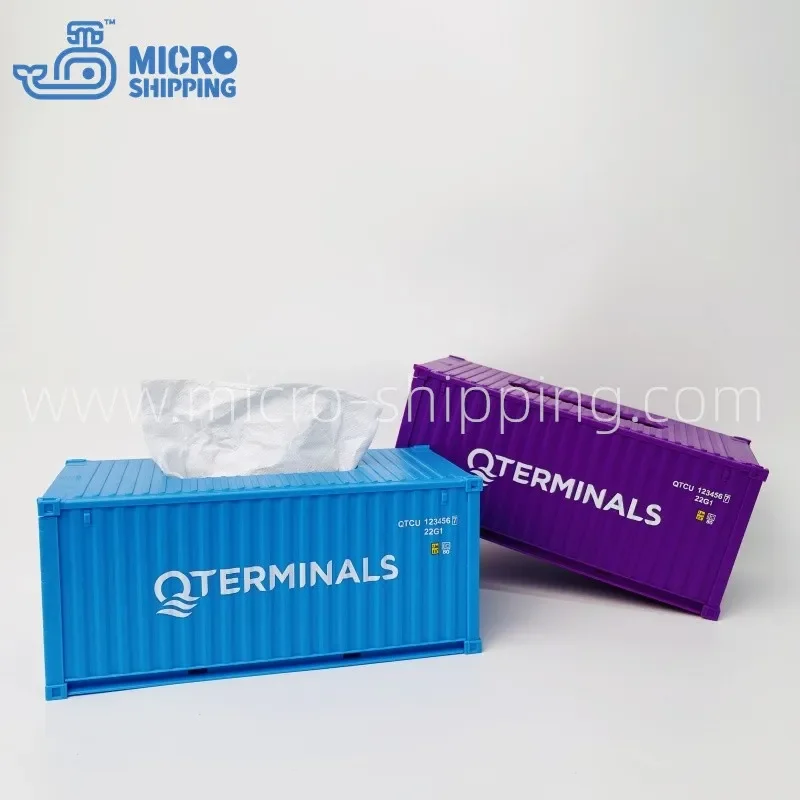
The standard body is 23 cm long, 11 cm wide and 10 cm high — the proportions of a 20-foot general-purpose container reduced to roughly 1:25. Those proportions are not decorative: the external dimensions of a real 20-foot box are fixed by ISO 668, and the miniature is imitating that geometry. In ABS it is light enough to post and stable enough to sit on a desk, a reception counter or a meeting table without sliding about.
| Specification | Standard build |
|---|---|
| Overall size | L 23 × W 11 × H 10 cm |
| Scale | 1:25 of a 20′ GP dry van |
| Material | ABS plastic (zinc alloy in the 1:30 edition) |
| Roof | Separate panel with an oval extraction slot |
| Livery | Plain, cartoon print, carrier or terminal livery |
| Minimum order | 300 pieces |
| Sample lead time | 1–2 weeks |
| Production | 30 working days after sample approval |
The number that matters when you buy is the internal clearance, not the outside dimension. A 23 cm body takes a standard soft-pack — the flat pack wrapped in plastic film that most markets sell — with spare room towards the door end. Cube packs and upright boutique boxes will not fit, and that is the first thing to check before you plan a programme around a particular tissue supplier.
If your offices use a different format in, say, Japan or the United States, tell us at quotation stage. The body can be adjusted, but the mould is what sets the cost, and it is always cheaper to choose the pack than to change the mould.
3. Loading a refill in five steps
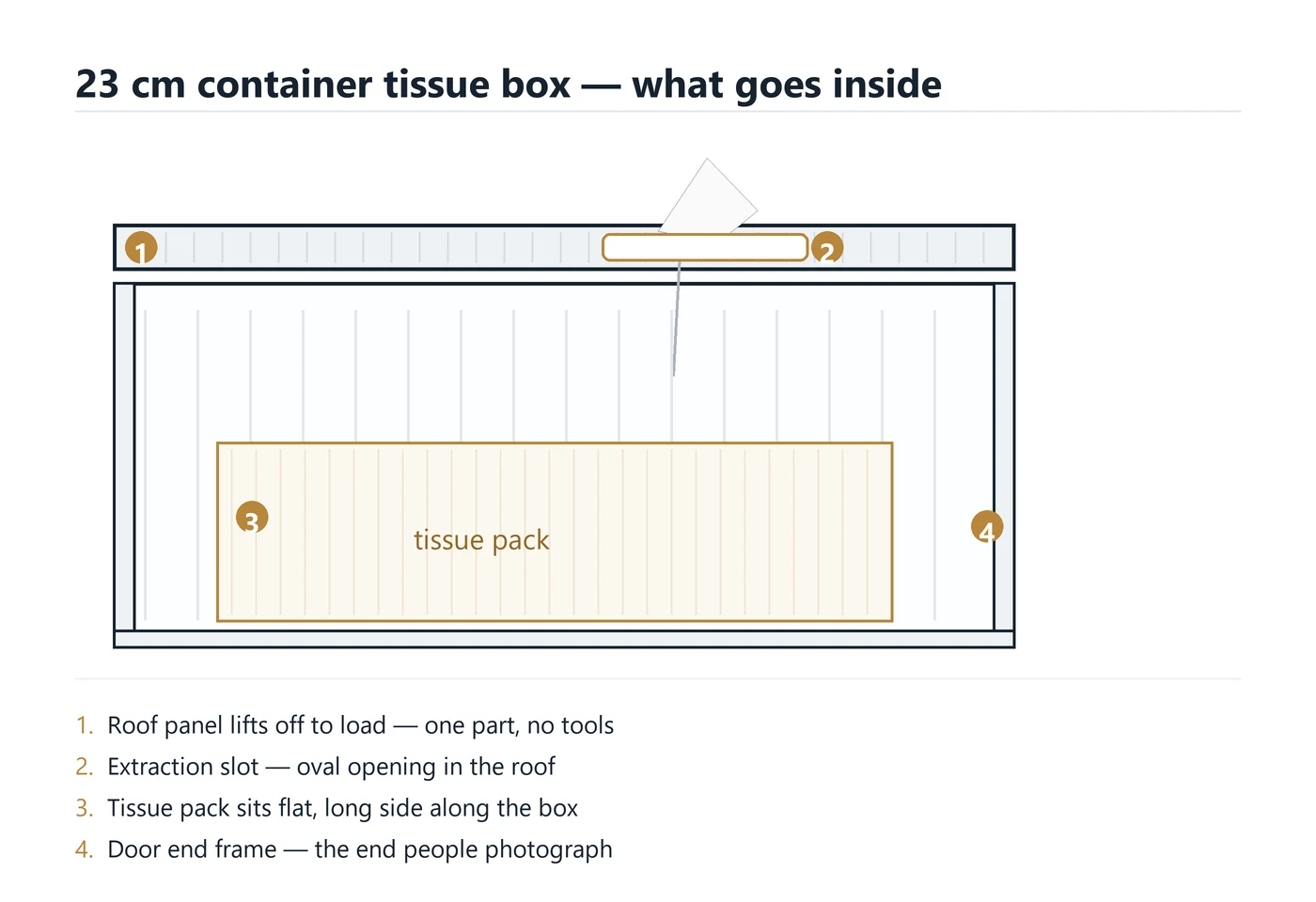
The box is built to be reloaded, not replaced. On the 23 cm ABS unit the roof is a separate moulded panel: it lifts away, the empty pack comes out, the new one goes in, and the panel presses back down. No tools, no clips to break, nothing to unscrew.
- Lift the roof. Hold the panel at both ends and pull straight up. It seats on the top rail, so it comes away cleanly once you break the initial friction.
- Take the empty pack out. Slide it towards the door end rather than pulling upwards, which is how the inner corrugation gets scratched.
- Open the new pack and pinch one sheet. Pull the first sheet clear of the film before the pack goes in. Doing it afterwards, through the slot, is where sheets tear.
- Lower the pack in, sheet first. Thread the sheet up through the slot as the pack goes down, then let the pack settle flat on the base with its long side along the box.
- Press the roof back on, then pull the first sheet. Seat the panel evenly, press along both long edges, and pull gently at a slight angle so the perforation opens instead of ripping.
Two minutes of care at step four saves a week of small irritations. A pack that sits at an angle feeds badly, and a sheet that is threaded before the roof goes back never tangles inside the body.
4. What makes a refill fit badly
Almost every complaint we hear about a container tissue box comes back to one of five things, and four of them happen in the first minute of loading.
The wrong pack format. Cube boxes are the usual culprit. They are square in plan, the body is not, and forcing one in bows the base and lifts the roof panel a millimetre — enough that the slot no longer sits flush.
A sheet pushed back down through the slot. Once a sheet disappears inside the body it will not come back up without the roof coming off. Pull it out from the top, reload the pack, and thread it again.
Two packs at once. It looks efficient and it does not work. The lower pack stops compressing, the upper one rides against the roof, and the extraction slot clogs.
Pulling sideways. The slot is an oval, not a tear strip. Pulling at 45 degrees drags the sheet across the rim and tears it below the perforation, which leaves a stub you cannot reach.
Damp storage. Cartons kept in an unventilated store room take on moisture, and a damp pack feeds in clumps. Keep spares in the original carton, off the floor, and rotate them.
5. ABS or alloy: two builds, two jobs
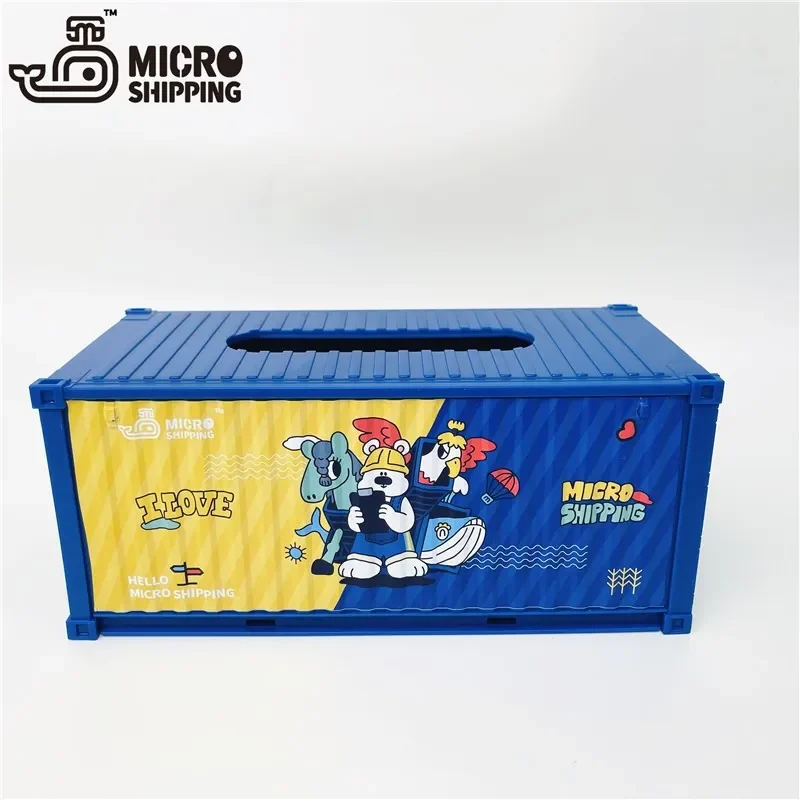
The 23 cm ABS body is the workhorse of the container tissue box family. It takes full-colour print across the corrugation, it survives being handled by hundreds of people at a trade fair, and at 300 pieces it lands inside most gifting budgets. It is also the version that can carry a cartoon or illustrative livery, which is why consumer-facing brands choose it.
The 1:30 zinc alloy edition is the executive piece. Die-cast metal holds a sharper edge on the door end and the corner castings, it has the weight people associate with a serious gift, and it takes a painted finish rather than a printed one. It costs more and it is worth it when the recipient is a customer's managing director.
| Specification | 23 cm ABS | 1:30 alloy |
|---|---|---|
| Feel in the hand | Light, rigid plastic | Heavy, cool metal |
| Livery method | Print or label over corrugation | Paint plus pad print |
| Best for | Volume gifting, trade fairs, driver and staff programmes | Executive gifts, terminal and carrier milestones |
| Minimum order | 300 pieces | 300 pieces |
6. Printing a livery onto corrugation
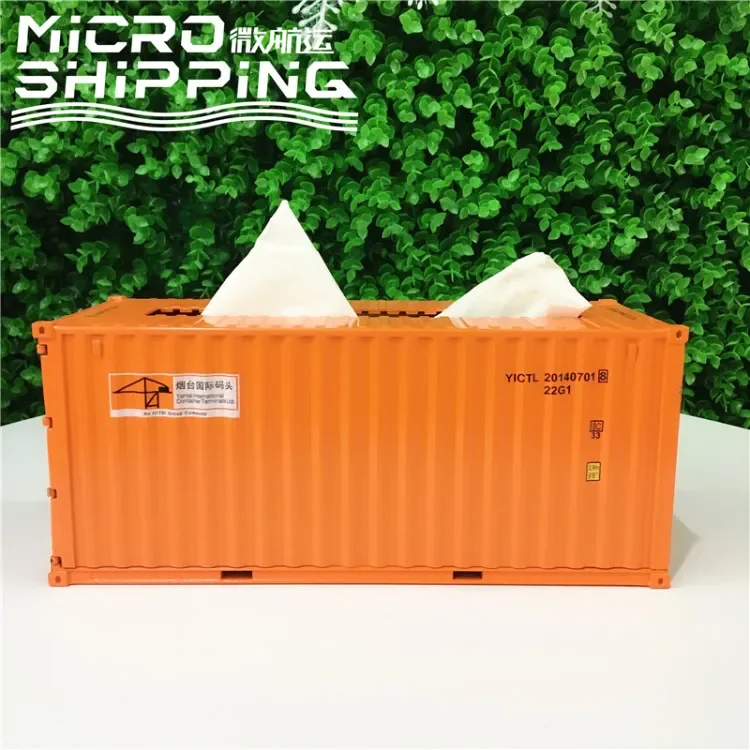
Corrugated panels are the hardest surface to print a container tissue box well, because the ink has to stay registered across every rib. Small type drifts on the crests, and a logo that looks crisp on screen can break up by the time it reaches the fifth corrugation.
We work from vector artwork, PANTONE or RAL references and the brand's own guidelines. Where a client sends a JPEG lifted from a website, we will say so before quotation rather than after: it cannot be scaled to a 9 mm door and its colours are whatever that screen decided.
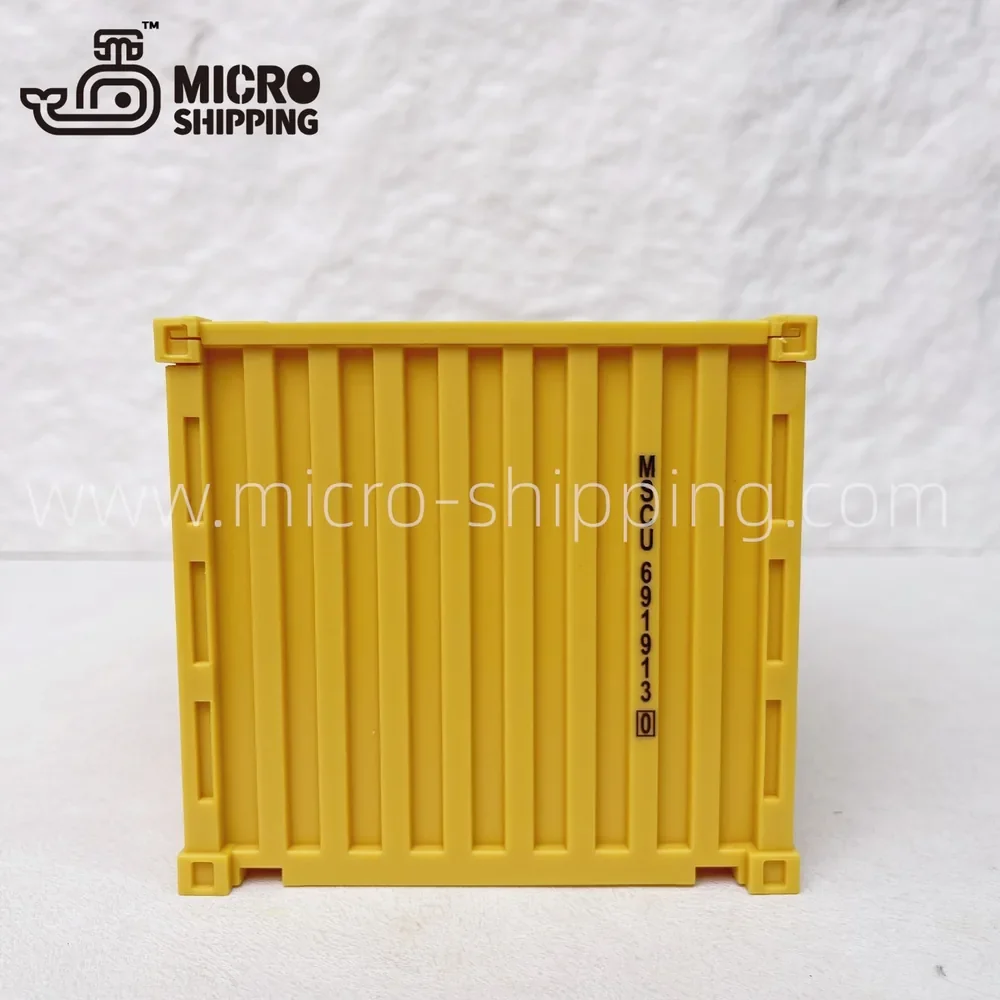
Markings are worth getting right. Owner code, serial number, check digit and size-and-type code — the system set out in ISO 6346 — are what a fleet manager reads first, and a fictional code is exactly the sort of detail that gets a gift quietly retired. Send us the real equipment data and we will set it as it appears on the unit.
7. Cleaning, and the second year on the desk
A container tissue box lives through flu season, dusty warehouses and the occasional coffee spill, so it needs to be cleanable. Warm water with a drop of mild washing-up liquid, a soft cloth, and a rinse are enough for the ABS body. Dry it before the roof goes back on.
Do not use solvents, acetone or abrasive cream, and do not put either version in a dishwasher — the heat will move the print and can warp a thin panel. For the slot, a cotton bud removes the paper dust that builds up along the rim and eventually drags on every sheet.
Keep it out of direct sun. ABS takes UV well but print does not, and a box that sits in a south-facing window for two years will show it.
8. Ordering: MOQ, samples and lead times
Minimum order for a container tissue box is 300 pieces, because the print set-up and the mould dominate the cost of a short run. Mixed liveries within one order are possible; each livery carries its own set-up, and the quotation shows that instead of hiding it.
Every programme starts with a pre-production sample. Sampling takes 1–2 weeks, and about a month for alloy; it is charged, and part or all of that charge is credited against the production order. We would rather you held the actual piece than approved a rendering.
Production runs 30 working days after sample approval, or 30–45 working days for alloy depending on the number of painted parts. A new body size means new tooling at 3–4 months. We quote EXW, FOB, CIF or DDP, and payment is by T/T.
9. Where to start
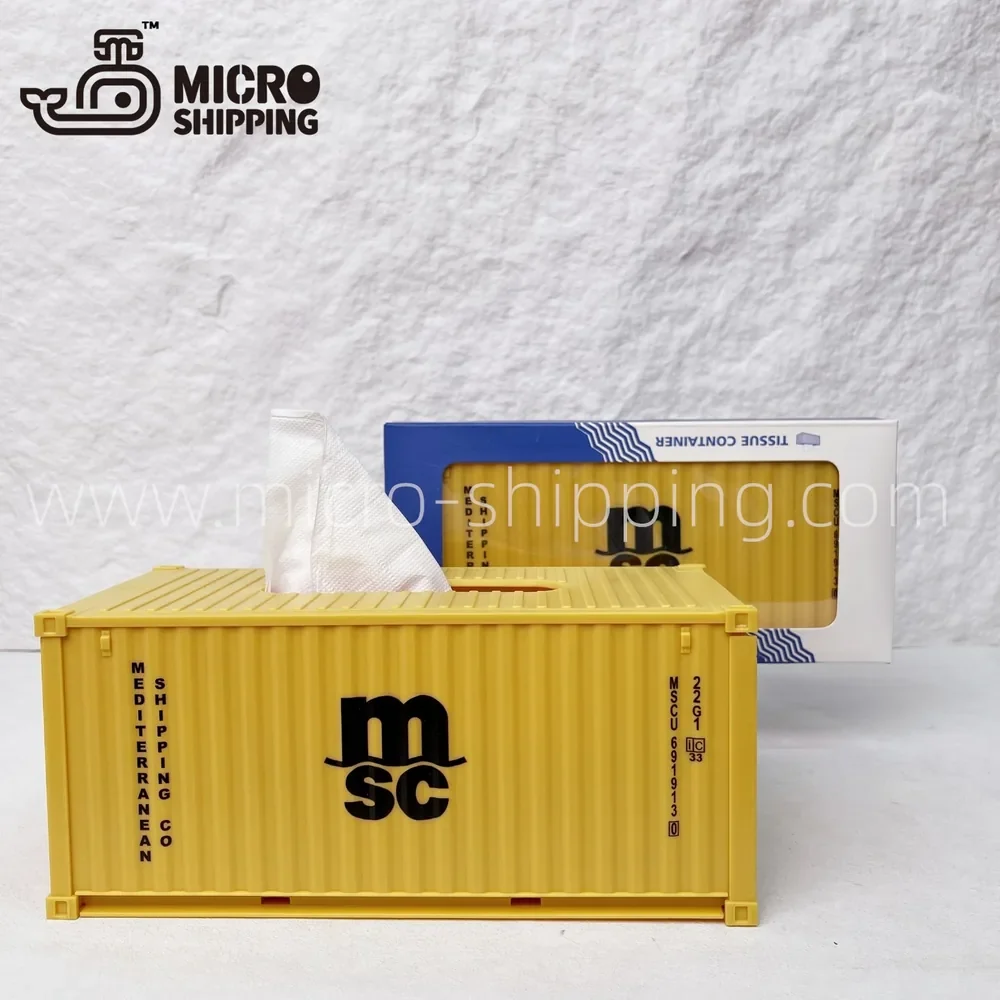
The standard bodies are in container tissue boxes, with the metal edition at 1:30 alloy container tissue box and a flat-pack version for volume programmes at 23 cm tissue container assembly box. Recent carrier programmes include a 1:25 MSC container tissue box.
If you are still deciding between a tissue box and a model, our model scale guide covers the sizes, and custom ship models for corporate gifts covers the larger end of a desk programme. Livery files and proofing are explained in customization.
Send four lines — quantity, livery, deadline and destination — to our quotation desk and you will have a price, a pack recommendation and a delivery date back on the next working day.