
Ask a fleet manager what a truck model is for and the answer is practical: it sits on the desk of the customer who moves their boxes, it goes into a driver's hands at a long-service award, it stands on a counter at a trade fair.
Yet most alloy truck models on the market are generic. What separates a generic one from a model that reads as your brand comes down to a handful of decisions — scale, mould, livery, and how honestly the brief was written.
We have been building them since 2012, alongside ship models and container replicas, for logistics brands in more than 120 countries and territories. This guide to the alloy truck model business is what we would tell a buyer in the first meeting: what "alloy" means, which scale suits which job, how livery is applied, and what sampling, MOQ and lead times look like from our side of the desk.
1. What "alloy" actually means
In our trade, alloy means zinc alloy die-casting — usually a zamak-type zinc alloy — for the parts that need weight and crisp edges: the cab shell, the chassis rails, the container body. Small details such as mirrors, mudguards, fuel tanks and interior hints are engineering plastics, and the tyres are rubber or soft PVC. The metal matters for two reasons.
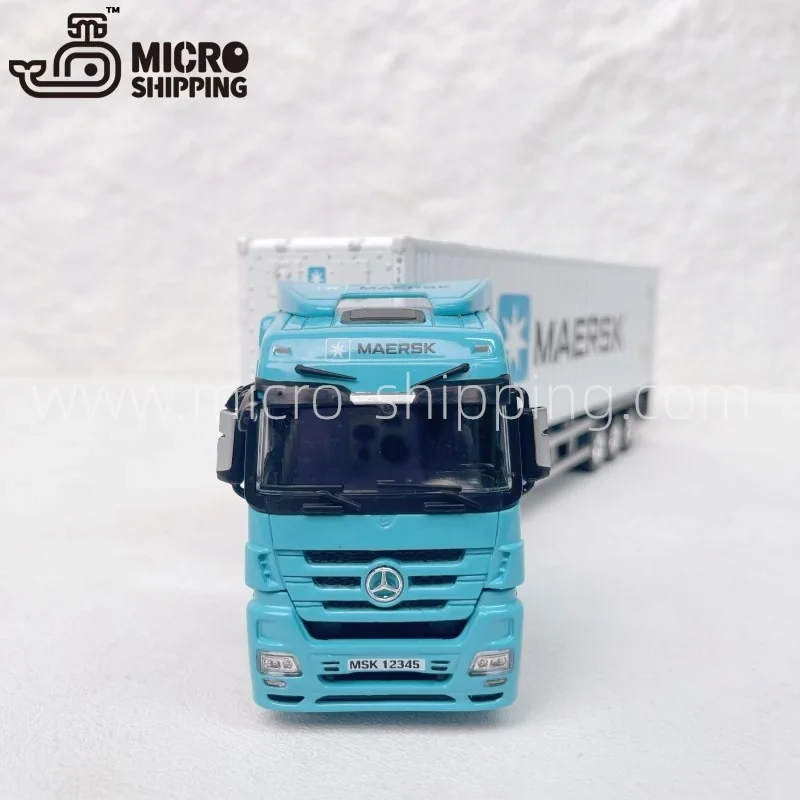
First, it gives the model the heft people expect from a corporate gift rather than a promotional toy. Second, it holds a sharper edge than resin, so the cab grille, the door shut lines and the container corrugation stay legible even at 1:87. A die-cast body also takes paint and pad printing cleanly — which is where a livery either looks right or looks like a sticker.
Resin and 3D-printed parts still have their place: short runs, unusual shapes, one-off executive pieces. But for an alloy truck model produced in the hundreds or thousands, die-cast alloy is the material that keeps unit cost and consistency in the same conversation.
2. Three scales, three jobs
Scale is not a taste question. It decides how much detail survives, how much the model weighs in the hand, how big the gift box is, and what the unit price can realistically be. Across the alloy truck model programmes we quote, three scales cover almost every brief.
| Scale | Model length | Best for | Our MOQ |
|---|---|---|---|
| 1:50 | about 26 cm | Boardroom and executive gifts, display and exhibition pieces | 50 pcs |
| 1:64 | about 19–20 cm | Desk gifts, customer appreciation, long-service awards | 500 pcs |
| 1:87 | about 14 cm | Large-volume giveaways, driver programmes, trade-fair handouts | 300 pcs |
The 1:50 is the one that reads from across a room. At roughly 26 cm it can carry a 40-foot container, opening rear doors on the trailer, a detailed cab interior and a presentation base without becoming furniture. It is the scale we recommend when the model is going to a customer's managing director or standing in a reception area.
The 1:87 alloy truck model is the workhorse of volume programmes: about 14 cm, light enough to post individually, small enough that a thousand units fit in a pallet or two, and still detailed enough that the livery reads at arm's length. If you are equipping a driver network or a trade-fair giveaway, this is usually where the budget lands.
The 1:64 alloy truck model sits between them and has become the most requested size for customer-appreciation gifts: about 19–20 cm, heavy enough to feel like a keepsake, small enough to sit on a desk beside a monitor. Its container is typically a 20-foot box, which keeps the proportions of the truck believable.
3. What separates a model from a toy
Two alloy truck models can use the same mould and still feel a generation apart. The difference is in the parts that a photograph at 800 pixels will not show but a customer's hand will. In our workshop, these are the checkpoints that decide whether a piece ships.
Proportion. The cab has to look like the make it represents, not like a generic truck. That means the windscreen rake, the height of the sleeper, the position of the mirrors and the shape of the bumper. Where a client has a specific tractor unit in the fleet, we model from drawings and photographs of that unit rather than an off-the-shelf cab.
Wheels and stance. A model that sits too high or too low reads wrong before anyone can explain why. Tyre diameter, rim depth and the gap between tyre and mudguard are set early and checked on every pre-production sample.
The container. Corrugation depth, corner castings, the door locking bars and the roof line, all checked against the ISO 668 dimensions for series-1 freight containers. This is where an alloy truck model earns its keep as a shipping-industry gift: the box on the back is the part your customer's own customers recognise.
Paint and print. Sharp colour breaks, no bleed under masking, no orange-peel on the cab, and print that stays legible on a corrugated surface. We check these under raking light, not just straight on.
The base and the box. A printed base plate with the programme name, a foam insert that holds the model without rattling, and a carton that survives international courier handling. Packaging is a specification, not an afterthought.
4. Turning a fleet into a livery
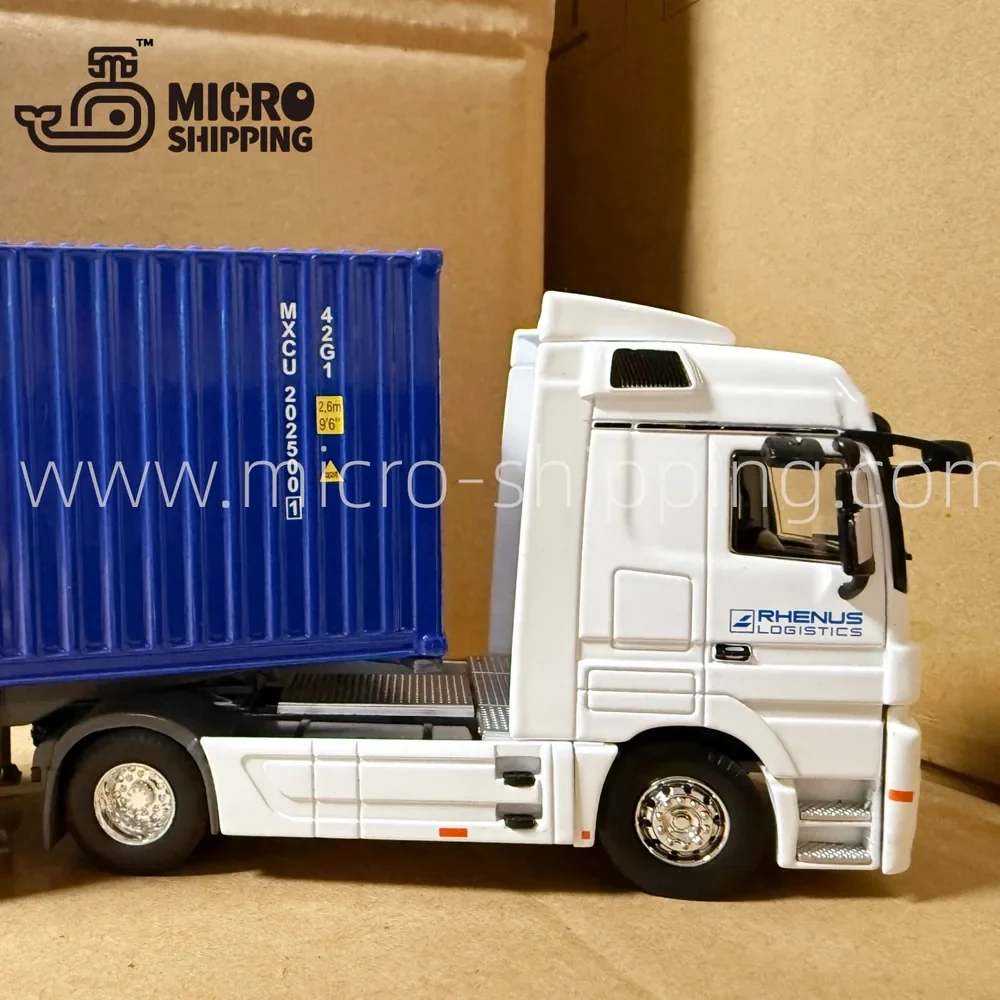
Livery is where most briefs succeed or fail, and it is almost always decided by the files clients send. To reproduce a livery accurately we need four things: a vector logo in AI, EPS or PDF; the brand colours as PANTONE or RAL references; the visual identity guidelines if they exist; and the fonts used in the wordmark.
A JPEG pulled from a website will not do. It cannot be scaled to a 9 mm cab door without going soft, and its colours are whatever the screen decided that day. Nor can a colour be matched by eye: two blues that look identical on a monitor can be visibly different once painted on metal, which is why we work from the reference code rather than a screenshot.
On an alloy truck model, branding usually goes in four places: the cab doors, the container side, the chassis rail, and a base plate or gift-box sleeve. Two or three colours travel best. When a livery needs more — a full photographic wrap, for example — we will say so at quotation stage, because the technique changes and so does the unit cost.
Markings are applied by pad printing or water-slide decals depending on the surface and the size of the artwork. Pad printing sits flatter on curved panels and survives handling better; decals allow finer multi-colour detail. On a 1:50 model we can usually run both on the same piece: print on the cab, decal on the container doors.
5. Sampling, MOQ and lead times
Every alloy truck model programme starts with a pre-production sample. Sampling is charged, and part or all of that charge is credited against the production order — we would rather you see the actual piece than approve a rendering. Sample freight is paid by the client, since it ships by courier to your door.
Standard production runs on 30 working days after sample approval. Alloy models run 30–45 working days depending on the number of painted parts and the complexity of the livery. Large volumes add 10–15 working days to the schedule. If the model needs a new mould — a tractor unit or a container type we do not already tool — allow 3–4 months for tooling, and 5–6 months in a peak season.
Minimum order quantities follow the scale, because the mould and the print set-up dominate the cost of a short run: 50 pieces at 1:50, 500 at 1:64 and 300 at 1:87. Mixed liveries within one order are possible and common; each livery needs its own print set-up, which is reflected in the quotation rather than hidden in it.
We quote EXW, FOB or CIF as standard, with DDP and DDU available on request, and payment by T/T. Where a programme runs across several years, we keep the mould, the colour references and the print files on file so that a reorder in eighteen months matches the first delivery.
6. A brief we can quote from
Six lines in an email is enough to give you a real number rather than a range. Send us these for your alloy truck model and we will come back with scale, material, livery method, tooling position, unit price and a delivery date.
- Scale and quantity — for example 1:50, 300 pieces, or "your recommendation for a driver network of 2,000".
- The unit to be modelled — tractor make and model if it matters, container type (20ft, 40ft, tank, reefer) and any fleet-specific details.
- Livery files — vector logo, PANTONE or RAL references, and where the branding should appear.
- Packaging — plain carton, printed sleeve, gift box, or a base plate with the programme name.
- Deadline and destination — the date the models must be in your hands, not the date you plan to hand them out.
- Sample requirement — whether a physical pre-production sample is needed before the order is confirmed.
7. Questions we are asked most
Can you match our fleet exactly? Yes, within the limits of the mould. Cab shape, container type, colour and markings can all be specified; a completely new tractor unit means new tooling. We will tell you at quotation stage which of the two you are buying.
Do the wheels roll? On most 1:50 and 1:64 alloy truck models yes, and the trailer can be unhitched. For giveaways where the model will be handled by hundreds of people, some clients prefer fixed wheels for durability — we will advise based on the use.
How many colours can the livery use? Two or three print colours cover most corporate liveries cleanly. Beyond that, decals or a printed wrap become more practical, and the quotation will show which route we recommend.
Can we mix liveries in one order? Yes. Each livery carries its own set-up cost, so the split matters more than the total quantity.
What about packaging with our branding? Printed sleeves, gift boxes and base plates are all part of the programme. Packaging artwork follows the same rule as the model: vector files and defined colours.
Where to start
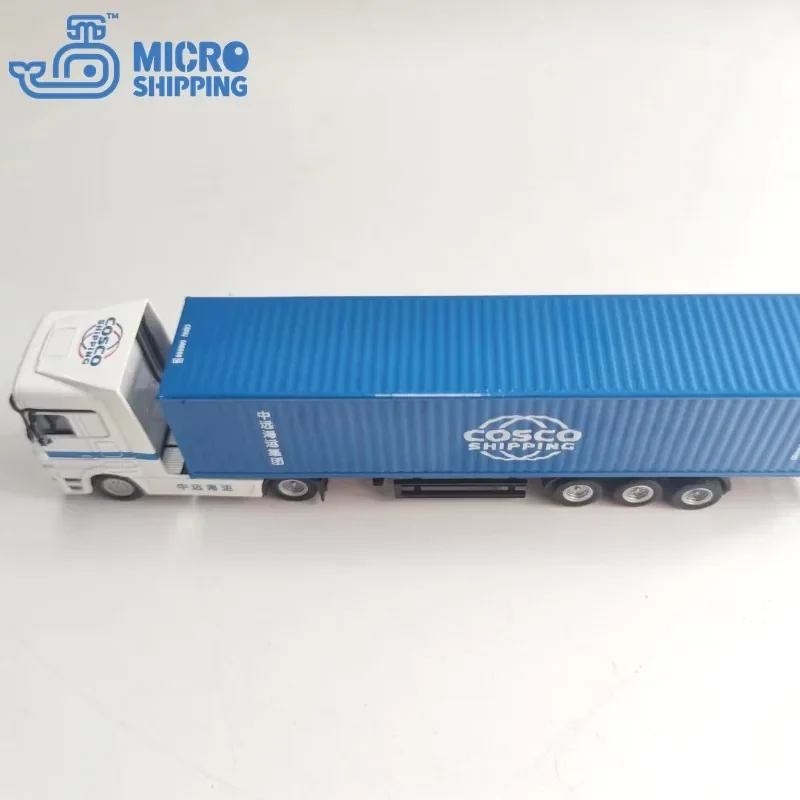
The range we build most often is in container truck models, with recent programmes including a 1:50 Maersk alloy truck, a 1:87 ONE truck and a 1:64 American container truck. If you are still deciding on size, the scale guide sets trucks beside ships and aircraft on the same logic, and customization explains how livery files are handled.
One practical note from fourteen years of these programmes: the models that get kept are the ones where the brief was specific.
A generic alloy truck model with a logo on the door is a giveaway. A generic alloy truck model with a logo on the door is a giveaway. A 1:50 alloy truck model of the exact tractor and container your customer sees at their loading bay is a piece they put on a shelf and explain to visitors. The difference is not the budget; it is the six lines of brief.
Send the six lines to our quotation desk and you will have a real price, a scale recommendation and a delivery date back on the next working day.